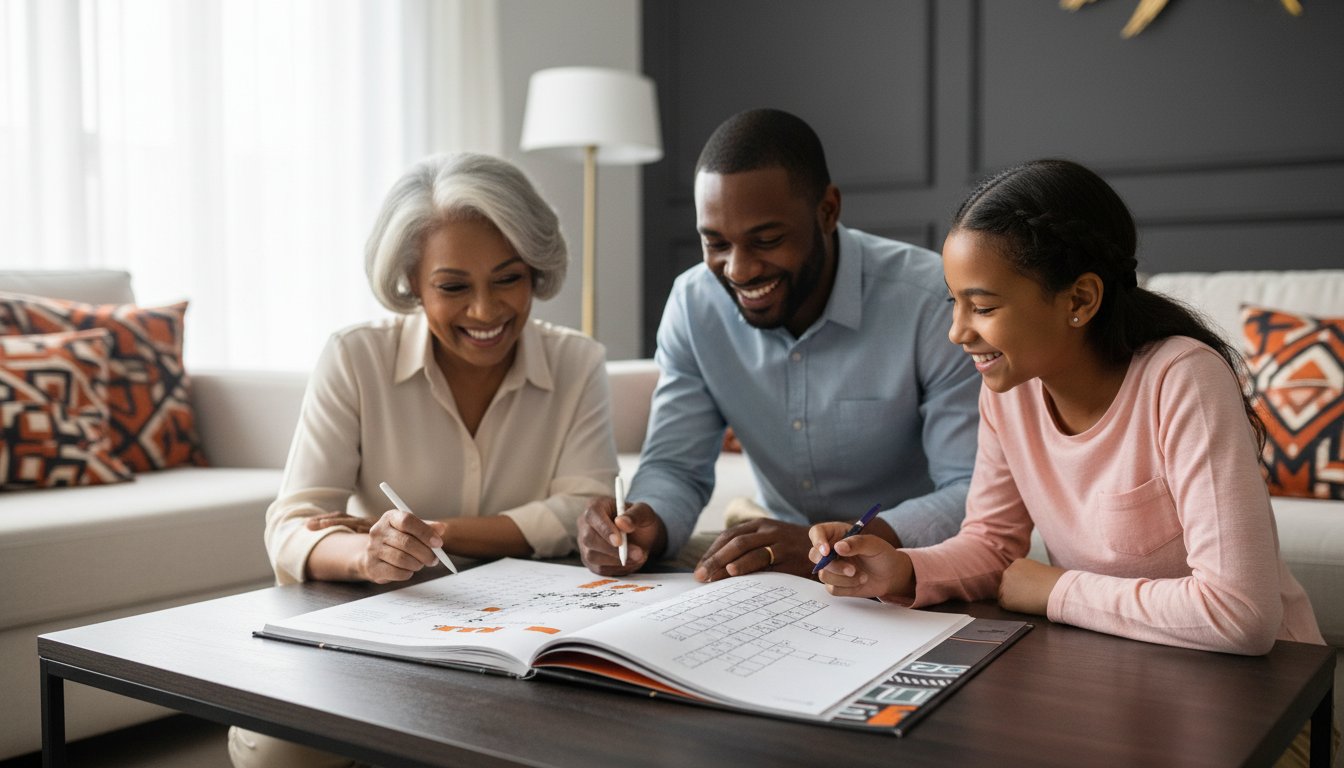
What if your living room could become a space where three generations connect without a single glowing screen in sight? We all feel the weight of digital fatigue. It’s often difficult to find games that actually look like us and speak our language. You want more than just a distraction; you want a ritual that celebrates Black culture and joy. A family puzzle night isn’t just a way to pass the time. It’s a shared cultural ritual that builds legacy through collective wisdom.
With the word games market reaching $9.4 billion in 2025, it’s clear that families are craving deeper mental engagement. This guide will help you transform a simple evening into a vibrant tradition of connection and mental agility. You’ll learn how to curate the perfect atmosphere. We’ll cover everything from selecting Afrocentric jigsaw designs to diving into the bite-sized fun of the BlackCrosswords: In Our Own Words Volume 2, arriving June 9, 2026. We’re showing you how to reclaim your family time with intention and pride.
Key Takeaways
- Learn to transform your family puzzle night into a deliberate cultural ritual that prioritizes screen-free connection across every generation.
- Discover how to curate a celebratory home environment that makes solving puzzles feel like a shared act of cultural affirmation.
- Understand the unique power of crosswords to spark deep conversations about the nuances and history of the African Diaspora.
- Master new collaborative play methods and icebreakers designed to keep participants of all ages engaged and mentally sharp.
- Explore the value of physical crossword collections as tangible keepsakes that document and celebrate Black culture and joy.
Beyond the Board: Why Family Puzzle Night is a Cultural Ritual
A family puzzle night isn’t just a way to fill a Friday evening. It’s a deliberate, screen-free sanctuary where we reclaim our attention from the digital world. While a simple activity might just pass the time, a cultural ritual anchors us in our identity. It’s about being present. It’s about seeing our stories reflected on the table. We’re moving beyond the idea of “just playing a game” and moving toward a practice of intentional connection.
Understanding the history of jigsaw puzzles shows how they’ve evolved from strictly educational maps into tools for social bonding. For Black families, this connection is deepened when the imagery and clues celebrate our specific heritage. This intentionality transforms a game into an act of belonging. We aren’t just matching shapes; we’re matching our collective experiences. It’s a moment to breathe, talk, and celebrate our community without the distractions of the outside world.
To better understand how different puzzles can enhance your group experience, watch this helpful video:
The benefits of this practice are twofold. On one hand, you’re sharpening the mind. Solving a complex grid or finding that one elusive edge piece requires focus, logic, and patience. On the other hand, you’re fostering emotional belonging. When the content of the puzzle centers on the Black experience, the activity feels like a warm embrace. It’s a rare space where intellectual challenge meets cultural comfort, making it a perfect environment for all ages to thrive together.
The Power of Centering Black Joy
Black joy is a form of wellness and a pillar of community strength. When we choose puzzles that feature cultural icons, vibrant neighborhoods, or scenes of everyday excellence, we’re practicing cultural intentionality. This matters because it tells our children that their world is worthy of focus. It builds pride before a single piece is even placed. Centering Black culture and joy in our leisure time ensures that our “down time” is also a time for uplift and affirmation.
Bridging the Generational Gap
These nights allow seniors to share history and wisdom naturally. As we work through a family puzzle night, stories about the past often surface. Collaborative problem-solving builds deep family trust between the youth and their elders. By starting this now, you’re setting a tradition that children will want to carry forward into 2026 and beyond. It creates a steady rhythm of companionship that turns a simple hobby into a lasting family legacy.
Setting the Vibe: Preparation for an Unforgettable Group Puzzle Activity
Hosting a successful family puzzle night requires more than just clearing the table. It is about intentionality. We want the space to feel like a celebration, not a classroom. Start by picking a central hub in your home where everyone can gather comfortably. The dining room table is usually the heart of the action. It offers enough space for everyone to lean in and collaborate. Clear away the daily clutter. Remove the mail and the laptops. This space is now dedicated to celebrating Black culture and joy.
Music is the secret ingredient for a great vibe. A curated playlist bridges the gap between the youth and the elders. Mix some classic Motown with modern Afrobeats or Neo-soul. This creates a sonic backdrop that keeps the energy high even when a clue gets tough. Pair this with snacks that honor your family traditions. Think of items that are easy to grab but won’t leave grease on your puzzle pieces. Pre-cut fruit, mixed nuts, or small handheld pastries work perfectly. Keeping hands clean ensures your puzzles remain family keepsakes for years to come.
Atmosphere and Intentionality
Lighting is everything. You need it bright enough to read small clues, but soft enough to feel cozy. Arrange seating to encourage face-to-face interaction rather than everyone staring at a screen. Try using a communal phone basket. Everyone drops their device at the door. This simple act tells your family that their presence is the priority. You can even use a specific candle or incense to signal that the ritual has begun. By the time June 2026 rolls around, these small sensory cues will trigger a sense of immediate relaxation for your loved ones.
Supplies for Success
Don’t let a lack of tools stall the fun. Have a stash of sharp pencils and high-quality erasers ready. For the seniors in the group, provide a few magnifying glasses. It is a small touch that ensures everyone can participate fully. Crossword puzzles now hold a 34.2% share of the global word games market because they are the ultimate tool for shared discovery. While some prefer printing individual sheets, using physical books often feels more substantial. It turns the activity into a tangible record of your time together. To keep the momentum going, consider starting a Family Leaderboard. Track who solved the most “mini” puzzles or who guessed the hardest cultural reference. It adds a layer of healthy competition that keeps everyone coming back.
To find the perfect centerpiece for your next gathering, you can explore our latest crossword puzzle books designed to spark conversation and celebrate our history.

Choosing Your Challenge: Jigsaws vs. Crosswords and Word Searches
Every family puzzle night needs a centerpiece that matches the energy of the room. While jigsaw puzzles provide a satisfying visual experience, word puzzles offer a unique linguistic connection. Jigsaws challenge our spatial reasoning. They’re great for quiet, meditative moments. Word games, however, invite a different kind of participation. They rely on shared knowledge and cultural references. By mixing these formats, you ensure that every family member finds a way to contribute to the collective win.
The global word games market reached a value of $9.4 billion in 2025. This growth reflects a massive shift toward activities that challenge the brain while fostering social bonds. Crosswords and word searches are leading this charge because they’re inherently conversational. You aren’t just looking for a piece of cardboard. You’re looking for a name, a place, or a moment in history that lives in your family’s memory. This turns your living room into a space of active discovery and Black culture and joy.
The Crossword Advantage
Crosswords are uniquely suited for sparking deep cultural conversations. Each clue acts as a mini-lesson in excellence. A clue might ask for a legendary Motown songwriter or a pioneering scientist from the diaspora. This naturally leads to “did you know” moments between elders and children. The collaborative nature of shouting out answers creates a lively atmosphere. It transforms the puzzle from a solo task into a team sport. If you’re new to the grid, learning how to solve crossword puzzles together is a great way to build collective confidence and mental agility.
Word Searches for the Whole Family
Word searches provide a perfect, low-barrier entry point for the youngest members of the tribe. They serve as an excellent warm-up activity to get everyone’s eyes in “puzzle mode.” Using themed searches allows you to introduce new vocabulary and names of historical figures in a way that feels like a game. It’s about more than just finding letters in a grid. It’s about seeing familiar names reflected in print. This sense of accomplishment for beginners helps them feel like vital parts of the family puzzle night tradition.
We highly recommend utilizing the “mini” format to keep the momentum high. These bite-sized challenges ensure that no one feels overwhelmed by a massive time commitment. You can complete several minis in one sitting. Each finished grid provides a fresh burst of dopamine and a reason to celebrate. This fast-paced rhythm keeps the energy vibrant and ensures the night ends on a high note of shared success.
Leveling Up the Fun: Game Variations and Icebreakers for All Ages
Once the music is playing and the snacks are ready, it is time to turn your family puzzle night into a dynamic event. We don’t just want people sitting in silence. We want laughter, debate, and those loud “Aha!” moments. The global board game market is estimated to reach $14.32 billion in 2026. This growth is fueled by families looking for more than just a game; they want an experience. To make your night stand out, move beyond individual solving and embrace the “Collaborative Crossword” method. One person acts as the “Caller,” reading clues aloud while the rest of the group brainstorms. This communal approach ensures that even those who are usually shy feel like part of the victory.
You can also introduce timed challenges that focus on “cultural speed.” Instead of just racing to fill in letters, set a five-minute timer to see who can identify all the clues related to specific decades or musical genres. This keeps the energy high and the brain sharp. To keep the stakes interesting, offer prizes that support other Black-owned businesses. Whether it’s a bag of specialty coffee or a handcrafted candle, these rewards reinforce the theme of community support. It turns a simple win into an act of collective uplift.
To get started with the right materials for your group, you can order our latest crossword puzzle books to ensure you have plenty of clues to keep the conversation flowing.
The Storytelling Clue Game
This icebreaker is perfect for bridging generational gaps. First, choose a crossword clue that references a historical figure, a specific city, or a soul food tradition. Second, ask the eldest member of the family to share a personal memory or a story related to that clue. Perhaps they remember seeing that artist in concert or growing up in that neighborhood. Finally, discuss as a group how that specific legacy still impacts your family today. This turns a simple grid into a living history lesson, making Black culture and joy the centerpiece of the conversation.
Team-Based Competition
For larger gatherings, try dividing the family into “Generational Teams.” It is Gen Z and Alpha versus the Boomers and Gen X. Use our “mini” puzzles for these rounds. Because the 5×5 grids are bite-sized and punchy, they are perfect for high-intensity, rapid-fire competition. These smaller formats lower the barrier to entry, ensuring that the kids don’t feel overwhelmed while the adults stay on their toes. The goal isn’t just to win; it’s to celebrate the collective wisdom of the room. When a team finally cracks a difficult cultural reference, the resulting cheer is a victory for the whole family.
Creating Lasting Memories with BlackCrosswords Collections
When the last clue is filled and the pens are put away, the experience of a family puzzle night shouldn’t just vanish. We believe in creating something that lasts. Our mission at BlackCrosswords is built on celebrating culture, history, and excellence in every single grid. These aren’t just games; they’re tangible records of our collective brilliance. By choosing physical crossword puzzle books, you’re building a library of Black culture and joy that lives on your coffee table or bookshelf for years to come.
We’ve designed our puzzles with a “moderate challenge” level in mind. This is intentional. We want you to feel a sense of pride and relaxation, not frustration. The goal is to spark a memory or a “did you know” conversation rather than sending you to a dictionary for obscure, academic terms. It’s about accessibility. It’s about making sure every member of the family, from the teenagers to the grandparents, feels the thrill of the “Aha!” moment. Supporting this movement means choosing representation over exclusionary mainstream games that often overlook our stories.
Why Representation Matters in Every Clue
The intentionality behind Jan Buckner Walker’s puzzle creation is what sets these collections apart. Every clue is a deliberate choice to center the Black experience. In many traditional crossword circles, the references can feel alienating or stuck in a narrow cultural vacuum. We offer a vibrant alternative. Our puzzles reflect the music, the slang, the heroes, and the triumphs that define us. This focus on excellence is part of a larger national movement. When you choose our books, you’re actively supporting Black-owned businesses and ensuring our narratives remain at the forefront of leisure and wellness.
Starting Your Collection
You can begin your journey with themed collections that span sports, literature, and politics. These physical books are designed to be passed down through the family. Imagine your children looking back at these solved grids in 2030 and seeing the names of the icons we celebrate today. It’s a beautiful way to document what mattered to us during our family puzzle night gatherings. With the release of Volume 2 on June 9, 2026, there’s never been a better time to grow your collection. We invite you to join our community of solvers who prioritize joy and representation. Let’s make every solved puzzle an act of cultural affirmation. Start your tradition today and keep the legacy of connection alive.
Start Your New Tradition of Cultural Joy Today
Your next family puzzle night is more than just a game. It’s a chance to reclaim your time and celebrate our collective brilliance. We’ve explored how to set the perfect vibe, use word games to spark deep conversation, and bridge the gap between generations through storytelling. By choosing activities that reflect our own stories, we turn a simple evening into a powerful ritual of belonging. It’s about moving away from digital fatigue and moving toward meaningful connection.
Since 2004, we’ve been dedicated to celebrating Black excellence. Our puzzles are created by Jan Buckner Walker, the trusted name behind the legendary Ebony and Essence crosswords. These collections offer a moderate challenge designed for relaxation and pride. They ensure that every member of the tribe feels seen and celebrated. It’s time to put away the screens and pick up a pencil. You can bring Black culture and joy to your next family night with our puzzle books and start building a legacy of connection. Let’s make every grid a moment of shared victory and cultural affirmation.
Frequently Asked Questions
What age is appropriate for a family puzzle night?
Every age from 5 to 95 can participate in this cultural ritual. Younger children often start with word searches to build their vocabulary, while adults and teens tackle the crossword grids. The goal is collective participation rather than individual perfection. By choosing puzzles that center on shared heritage, you ensure that even the youngest members feel a sense of belonging and pride as they recognize familiar names.
How long should a typical puzzle night last?
A window of 60 to 90 minutes is usually the sweet spot for keeping everyone engaged. This timeframe allows your family to complete several “mini” puzzles and engage in meaningful conversation without hitting a wall of mental fatigue. It’s long enough to establish a vibe with your playlist and snacks, but short enough to leave everyone wanting to return for the next session.
How do I keep teenagers interested in a family puzzle night?
Give teenagers a leadership role, such as being the “Caller” who reads clues or the curator of the night’s playlist. You can also introduce high-intensity “speed rounds” using 5×5 mini grids to appeal to their competitive nature. When the clues reference modern cultural icons and current excellence, teens are much more likely to stay focused and contribute their specific knowledge to the group win.
What are the best types of puzzles for seniors with memory concerns?
Familiar word searches and crosswords with nostalgic cultural clues are excellent for seniors. These activities provide vital cognitive maintenance for the 55 million people globally living with dementia as of 2024. Clues that trigger memories of music, historical events, or family traditions act as a form of reminiscence therapy. This helps seniors stay sharp while feeling like an essential part of the family’s intellectual circle.
Can we host a puzzle night if we only have 30 minutes?
Yes, you can absolutely host a family puzzle night in just 30 minutes by focusing on the “mini” format. These bite-sized 5×5 grids are designed to be solved in 5 to 10 minutes, providing quick wins and immediate satisfaction. Even a short session can act as a powerful “digital reset” for the family, proving that intentional connection doesn’t always require a massive time commitment.
What should we do if a crossword puzzle is too difficult for the kids?
Turn the difficult clue into a collaborative teaching moment rather than a roadblock. Read the clue aloud and share a brief story or a fact about the person or event it references. This shifts the focus from “getting the right answer” to “learning our history.” You can also let the kids “own” the word search version of the same theme to keep their confidence high.
How do I choose a theme for our first cultural puzzle night?
Start with a broad, celebratory theme like “Musical Legends” or “Pioneers of Excellence” to ensure there is something for every generation. Aligning your theme with current events, such as the June 9, 2026 release of a new puzzle volume, can also build anticipation. Picking a topic that your family already loves makes the transition into this new ritual feel natural and exciting for everyone involved.
Is it better to use digital puzzles or physical puzzle books for groups?
Physical puzzle books are the superior choice for a family puzzle night because they encourage face-to-face interaction and eliminate screen glare. With crosswords holding a 34.2% share of the word games market in 2025, the trend is moving back toward tangible, shared experiences. A physical book allows multiple people to lean over the table together, making the act of solving feel like a true community effort.